
 Martin Howard
This article is not meant to be controversial. However, because of how the world has moved away from God’s Word, it will be taken as just that.
For nearly 2000 years, women were not allowed to function or be ordained as pastors in the Christian church. Or hold any leadership position in it. Paul explains why in 1 Timothy 2:12-14, “And I do not permit a woman to teach or to have authority over a man, but to be in silence. 13 For Adam was formed first, then Eve. 14 And Adam was not deceived, but the woman being deceived, fell into transgression.”
It’s not because women aren’t capable of performing the duties. Quite the contrary. Women are often more involved in the church than men. There are far more women’s ministries than men’s.
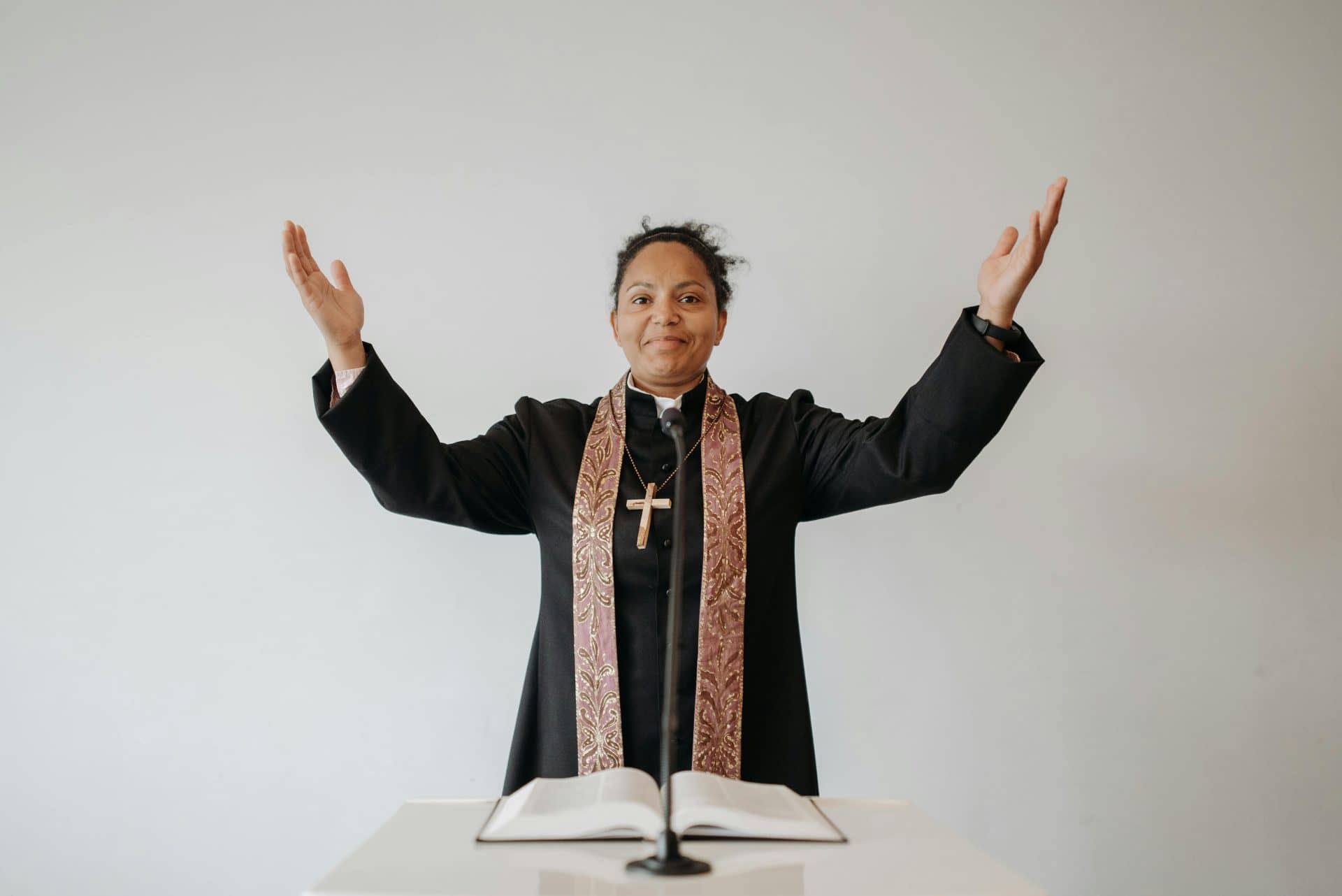
Why can’t women be pastors?
If you’ve been attending church for any length of time, you’ll know that women often study the Bible more than their husbands. And overall, women are better known as prayer warriors than men.
Even so, women are specifically forbidden from being an elder (aka overseer, reverend, minister, pastor, bishop, etc.) in God’s church.
Why are there so many women evangelists, so-called pastors, and apostles entering the scene?
That’s a great question!
There are so many women pastors, evangelists, apostles, and church leaders today because several denominations have allowed the Devil to take up residence in their skewed versions of Christianity (e.g., Methodist, United Methodist, Pentecostal, Word of Faith, New Apostolic Reformation, Christian and Missionary Alliance, etc.), by denying God’s Word and allowing women to be ordained as pastors.
But don’t take my word for it. Here’s what the Bible actually says about women and pastors:
1 Timothy 2:12-14 (NIV) – “I do not permit a woman to teach or to assume authority over a man; she must be quiet. 13 For Adam was formed first, then Eve. 14 And Adam was not the one deceived; it was the woman who was deceived and became a sinner.”
1 Timothy 3:1-7 (NIV) – “Here is a trustworthy saying: Whoever aspires to be an overseer desires a noble task. 2 Now the overseer is to be above reproach, faithful to his wife, temperate, self-controlled, respectable, hospitable, able to teach, 3 not given to drunkenness, not violent but gentle, not quarrelsome, not a lover of money. 4 He must manage his own family well and see that his children obey him, and he must do so in a manner worthy of full respect. 5 (If anyone does not know how to manage his own family, how can he take care of God’s church?) 6 He must not be a recent convert, or he may become conceited and fall under the same judgment as the devil. 7 He must also have a good reputation with outsiders, so that he will not fall into disgrace and into the devil’s trap.”
1 Corinthians 11:2-3 (NIV) – “I praise you for remembering me in everything and for holding to the traditions just as I passed them on to you. 3 But I want you to realize that the head of every man is Christ, and the head of the woman is man, and the head of Christ is God.”
1 Corinthians 11:7-12 (NIV) – “A man ought not to cover his head, since he is the image and glory of God; but woman is the glory of man. 8 For man did not come from woman, but woman from man; 9 neither was man created for woman, but woman for man. 10 It is for this reason that a woman ought to have authority over her own head, because of the angels. 11 Nevertheless, in the Lord woman is not independent of man, nor is man independent of woman. 12 For as woman came from man, so also man is born of woman. But everything comes from God.”
1 Corinthians 14:33-38 (NIV) – “For God is not a God of disorder but of peace—as in all the congregations of the Lord’s people. 34 Women should remain silent in the churches. They are not allowed to speak, but must be in submission, as the law says. 35 If they want to inquire about something, they should ask their own husbands at home; for it is disgraceful for a woman to speak in the church. 36 Or did the word of God originate with you? Or are you the only people it has reached? 37 If anyone thinks they are a prophet or otherwise gifted by the Spirit, let them acknowledge that what I am writing to you is the Lord’s command. 38 But if anyone ignores this, they will themselves be ignored.”
Titus 1:5-9 (NIV) – “The reason I left you in Crete was that you might put in order what was left unfinished and appoint elders in every town, as I directed you. 6 An elder must be blameless, faithful to his wife, a man whose children believe and are not open to the charge of being wild and disobedient. 7 Since an overseer manages God’s household, he must be blameless—not overbearing, not quick-tempered, not given to drunkenness, not violent, not pursuing dishonest gain. 8 Rather, he must be hospitable, one who loves what is good, who is self-controlled, upright, holy and disciplined. 9 He must hold firmly to the trustworthy message as it has been taught, so that he can encourage others by sound doctrine and refute those who oppose it.”
Please note, this not only means that women cannot be pastors, but they are not to pray, preach/teach, or lead in the church service either.
It doesn’t matter how much a woman wants to be a pastor or leader in the church; the Bible specifies that she is not to be one.
If you know your Bible, you’ll also know that the Apostle Paul penned each of those referenced passages.
Can we truly trust the source if these scriptures were all written by the same person?
If these passages were all written by Paul, where did he get his direction and knowledge from?
2 Timothy 3:16 – “All Scripture is given by inspiration of God, and is profitable for doctrine, for reproof, for correction, for instruction in righteousness.”
Let’s break this down into two different parts, starting with what Paul stated regarding where he got his authority.
“Dear brothers and sisters, I want you to understand that the gospel message I preach is not based on mere human reasoning. 12 I received my message from no human source, and no one taught me. Instead, I received it by direct revelation from Jesus Christ.” – Galatians 1:11-12 NLT
So, Paul is saying that what he wrote and taught was given to him by Jesus Christ directly.
Perhaps, some of these churches that have chosen to ordain women believe that because there’s only a small number of scripture references stating that women shouldn’t be pastors (and they are from the same source) that it’s not relevant.
Okay, let me approach that Hasty Generalization fallacy this way. Most churches preach that as a believer and an attendee of their church, you should tithe. And they specify the tithe as being 10% of your earnings.
Did you know that there are only three verses in the entire Bible that state the tithe is 10%?
Those are: Genesis 14:20, Leviticus 27:30, and Deuteronomy 14:22.
Did you notice something there? Genesis, Leviticus, and Deuteronomy were all written by Moses.
Uh-oh.
Wait a minute. The same churches that say they can’t trust the several passages of scripture stating women can’t be pastors or in leadership positions in the church, are willing to die on the hill of a 10% tithe?
There is far more written about pastors and leaders in the church being male than there are written about the tithe being 10%.
I wanted to note that in the New Testament, there are no verses that specify the tithe is 10%.
Why is this important?
When you study the Bible or any form of literature, you must understand to whom it was written. In this case, the New Testament was written primarily to Jews and Gentiles (non-Jews). In these specific passages, it was to Jews who were converted. And they knew the tithe was 10%. Therefore, there was no need to restate what was already commonly understood.
In the same way, it’s not necessary to state over and over again that women are not to be pastors, bishops, elders, deacons, etc., or hold positions of authority over men.
What about Phoebe in Romans 16:1?
Romans 16:1-2 – “I commend to you our sister Phoebe, a deacon of the church in Cenchreae. 2 I ask you to receive her in the Lord in a way worthy of his people and to give her any help she may need from you, for she has been the benefactor of many people, including me.”
The focus here is the word “deacon.”
Romans is another book written by the Apostle Paul. In 1 Timothy 3, Paul specifies the criteria for being a deacon.
1 Timothy 3:8-13 – “Likewise deacons must be reverent, not double-tongued, not given to much wine, not greedy for money, 9 holding the mystery of the faith with a pure conscience. 10 But let these also first be tested; then let them serve as deacons, being found blameless. 11 Likewise, their wives must be reverent, not slanderers, temperate, faithful in all things. 12 Let deacons be the husbands of one wife, ruling their children and their own houses well. 13 For those who have served well as deacons obtain for themselves a good standing and great boldness in the faith which is in Christ Jesus.”
Notice that a deacon is to be a man! Specifically, a man with a reverent wife.
So, why would Paul tell Timothy that deacons must be men yet send praises to the church in Rome about a deacon who is a woman?
This would be due to a translation error.
Let me explain a little bit about translation errors. In several New Testament books, Paul, James, Peter, Timothy, and John all refer to themselves as slaves to Christ. The word for “slave” has been interpreted as “servant” or “bondservant” in some translations. But those are wrong interpretations or translations of the word used.
In the case of the word “slave,” the intentional misinterpretation was due in large part to the stigmatism of the word slave as associated with American slavery in the 19th century. Therefore, many translators intentionally avoid using the correct word in favor of a more palatable one. But the word means “slave.” Whether voluntary or involuntary.
In the same way, the word Paul uses in Romans 16:1 describes an individual who serves with the overseers or elders of the church in a variety of ways. Not as a deacon as described in 1 Timothy 3. So, Romans 16:1 would be better translated as servant or someone who serves.
The same is true for the way Paul praises Priscilla and Aquilla in Acts and Romans.
Just because God used women in the early church doesn’t mean God suddenly changed His mind on their role in the church overall (slippery slope fallacy).
More denominations ordaining women pastors.
In 2023, the Christian and Missionary Alliance stance changed to align with other heretical church denominations to allow women to be ordained as pastors in the church.
“Culminating from the four-year National Discussion were a series of recommendations regarding the polity of men and women in spiritual leadership. The adopted recommendations upheld that eldership in Alliance churches consists of the lead pastor, elected lay elders, and other male members of the licensed ministry staff as deemed appropriate by the local church. In addition, delegates approved that the designation “Consecrated and Ordained” be used to indicate the denomination’s endorsement on all official workers, both male and female, who meet the stated qualifications for Alliance ministry and have successfully completed the consecration and ordination process outlined in the Manual of The Christian and Missionary Alliance. Official workers may also carry the title of “pastor” or “reverend” for specific ministry roles at the discretion of local church leadership.” – The Alliance Affirms its Beliefs, Empowers its Churches
As more and more of this happens, these “theologians” will use that decision as reason enough to allow women to be ordained and enthroned as pastors in the Protestant Church. In turn, other denominations are now allowing it to take place. Stating rebuttals like, “It was a misunderstanding in the church in Corinth. Certain women were doing things they weren’t supposed to. But that directive wasn’t meant for everyone.”
In the world of logical fallacies, this would be a combination of “circular reasoning,” “appeal to authority,” and “appeal to ignorance.”
Logical Fallacies:
Logical fallacies are errors in reasoning that undermine the logic of an argument. Here is a comprehensive list of common logical fallacies with brief explanations.
Common Logical Fallacies
- Ad Hominem: Attacking the person making the argument rather than the argument itself. For example, “You can’t trust John’s opinion on climate change because he’s not a scientist.”
- Straw Man: Misrepresenting someone’s argument to make it easier to attack. For instance, “People who support space exploration just want to waste money instead of solving problems on Earth.”
- Appeal to Ignorance (Argumentum ad Ignorantiam): Claiming something is true because it has not been proven false, or vice versa. For example, “No one has proven that aliens exist, so they must not be real.”
- False Dilemma (Either/Or Fallacy): Presenting two options as the only possibilities when more exist. For example, “You’re either with us or against us.”
- Slippery Slope: Arguing that a small first step will inevitably lead to a chain of related events resulting in a significant (usually negative) effect. For example, “If we allow students to redo tests, soon they’ll expect to redo every assignment.”
- Circular Reasoning (Begging the Question): When the conclusion of an argument is assumed in the phrasing of the question itself. For example, “I’m trustworthy because I always tell the truth.”
- Hasty Generalization: Making a broad conclusion based on a small or unrepresentative sample. For example, “My two friends from that city are rude; therefore, everyone from that city must be rude.”
- Post Hoc Ergo Propter Hoc: Assuming that because one event followed another, it was caused by it. For example, “I wore my lucky socks, and we won the game; therefore, my socks caused the win.”
- Appeal to Authority: Claiming something is true because an authority figure believes it, without any other supporting evidence. For example, “A famous actor says this diet works, so it must be effective.”
- Red Herring: Introducing irrelevant information into an argument to distract from the original issue. For example, “Why worry about climate change when there are so many homeless people?”
So, the only way I would ever support a woman pastor would be if Jesus Christ himself returned and said to me, “Regardless of what I said before, I now allow women pastors to shepherd my flock.” Beyond that, there’s 0% chance – because I know what the Bible says about it!
If you found value in this article, consider reading Who’s the Leader of Your Family?




Posts like this are why I keep coming back. It’s rare to find content that’s simple, practical, and not full of fluff.